How were games created? What was the corresponding effort for the design, the programming and ultimately the game mechanics? How can diachronic efforts be compared?
Game( existing technology of the time ) – Game depends on the technological possibilities
One idea is to take a game and see how complex it was to realise this game in the respective time with the respective default game technology. So the question is not about on-the-edge games – these were different depending on the platform anyway – but about a simple game realised through time and, where not available, ‘recreated’ as an experimental archaeology.
Approach: Classics>Today
Of course, there are games that have been realised time and again throughout the history of gaming, such as the classic games like PacMan or Galaxy etc. This would be a classic-today approach. This would be a classic-today approach. There are already series – especially in magazines – that show these developments. The problem here is that development is seen as a forward-looking ‘development’ and there is little discussion about possible twists and turns.
Approach: Today>Yesterday
Another approach – and the one favoured here – is to take a game that has since been discarded, which appeared relatively late (Flash game) and which, unlike all the games of the 80s, has no real setting and is also actually an ‘endless runner’. In other words, a game that could have been made very early on, but – as of 2023 – has no concrete predecessor. And neither mechanically nor visually (abstractly). The game should also be easy to realise and be able to show some patterns of game design.
SQUARES (Flash)
// Still to be found – did this version ever exist?
// Todo: Enquiry @ gavin
Developer: Gavin Shapiro
Or was the original game even called SQUARED? (IPhone?)
https://iphonetech78.wordpress.com/2009/11/02/squared-game-review/

SQUARES 2 (Flash) 2010?
2006: https://gigazine.net/gsc_news/en/20061006_squares2/
SQUARES 2 is currently being used. SQUARES 2 introduced extras into the gameplay. These can be easily removed.
Developer: Gavin Shapiro
„Squares 2, a popular flash game from the early 2000s. Set to the beat of Daft Punk’s 1997 song Revolution 909, you guide your cursor to black squares while avoiding the red ones.“
https://archive.org/details/squares2_202011

The concrete basic game mechanics (Squares 1):
In principle, there are objects – squares. These differ in colour (red, black) and size. There is a kind of friend-foe distinction (coding). Black is good, red is evil. The objects move horizontally or vertically. They do not influence each other. The player controls an avatar via the mouse (Flash) – a rotating black square. There is therefore relatively absolute control in the gameplay. The game ends when the avatar touches a red square. New objects are constantly being added.
Points are awarded for ‘collecting’ black squares. Depending on the size, more or fewer points are awarded. The micro-mechanics are correspondingly simple: avoid the red squares and collect the black ones. The macro mechanic is to score as many points as possible (or to hold out as long as possible). The speed of the game increases steadily, there is a kind of levelling system (speed and number of squares).
There are also strategic action decisions, as the whole thing is a kind of dynamic labyrinth. The player* must therefore anticipate where paths will be created (few red squares, etc.) and where risks can be taken. The edges, for example, are interesting, but also dangerous – because you can’t see what’s coming.
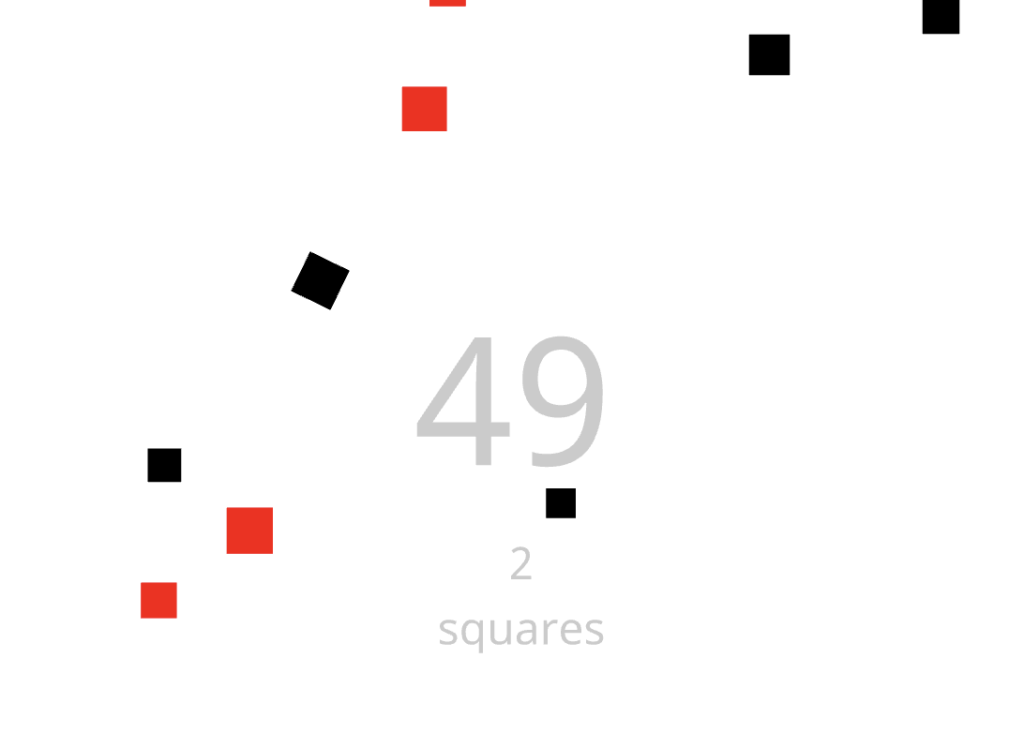
SQUARES 2 on the InternetArchive:
https://archive.org/details/squares2_202011
Technical conditionality
Technically, the game is banal from today’s perspective. Management of different objects, different sizes that can fly in 4 directions, different speeds and a box collision system for avatar vs. all objects. Graphics: Very simple with the most primitive kind of primitives – rectangle concrete square. Easy to realise.
Squarez 2014 (Intellivsion 1979+, Assembly)
Implementing squarez on the Intellivision was very easy. On the one hand, there are simple examples. A console is primarily designed to make games. All functionalities were available: Sprites, simple joystick support, display of text for the high score. These are all things that later home computers lacked by default directly in assembler.
SQUAREZ 2016 (Vectrex 1982+)
Vectrex is technically an interesting console. The technical background is very good: a 6803 processor, the blueprint for the 6502, easy to programme and consistent compared to the 6502. And then of course the vector screen. This requires new and different design challenges. Everything has to be drawn in one stroke. There are 3-4 lines per sprite. But things also look very modern = abstract. It is more difficult to differentiate between the various blocks. Here it would actually be easier to switch to a setting. There are no sprites. In other words, the whole thing is like developing a modern pre-Unity and Unreal game. More or less management work. Everything is contained in the data (so there is no position data in the sprites).
Compare this with the resulting game:
VecZ and the demo .
Squarez 2023 (C64, 6510 Assembly)
// ToDo: Details …
Squarez Amiga 2024
Here it is clear: it would be possible to make a concrete setting, the whole thing would not have to be abstract. Throughout the development process, you are tempted to realise the whole thing with a setting like tanks, aliens or soldiers.
ToDo: More details about the development process.
More about the reactions here: https://research.swissdigitization.ch/?p=2490
Squares ( Flash ) Original
Discussion on Flash implementation.
https://archive.org/details/squares2_202011
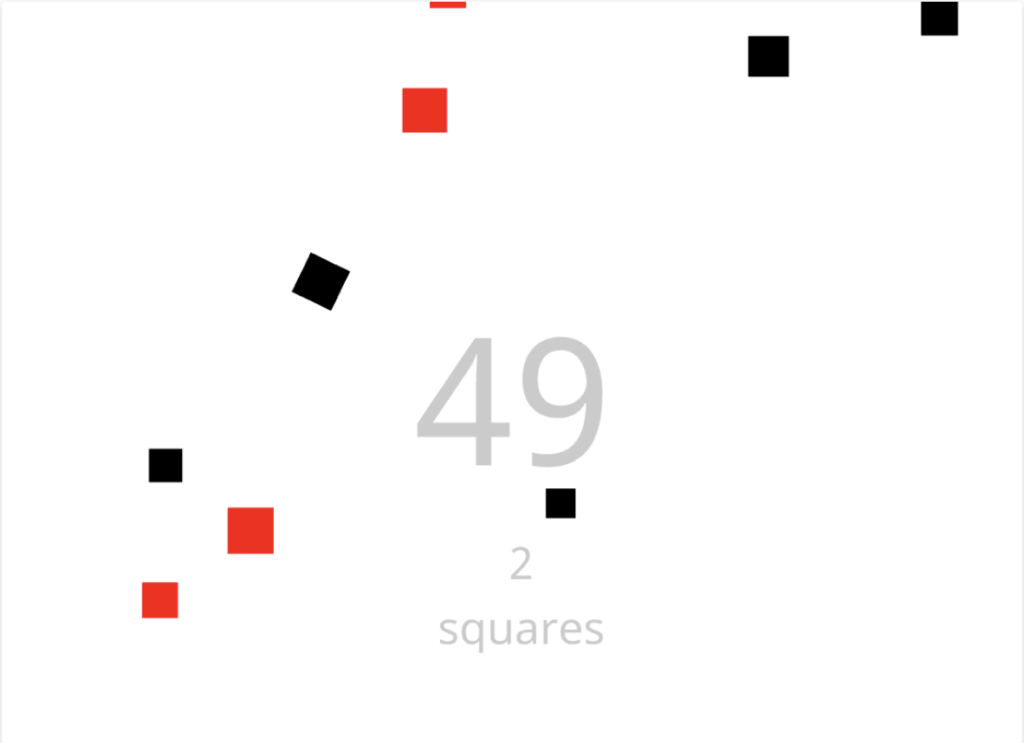
Squarez (Unity3d)
not yet done. to easy .-)
SquareU ( Unreal – BluePrint )


https://imachina.zhdk.ch/index.php?id=114460&argument=&argumentsub=
SquareZ (Pico8 – Fantasy Console)
In fantasy consoles, speed is not a problem, which means that everything is easily achievable.

https://www.lexaloffle.com/bbs/?tid=34622
// Todo: Beschreibung & Kategorien