LINEL was a software developer and publisher based in Switzerland. It had its headquarters in St.Gallen, Liechtenstein and Appenzell. The label was active from 1987 to 1995. LINEL was founded by seven or eight young Swiss developers in 1987. They focused on programming on Amiga and Atari ST but did some Commodore 64 ports and later DOS ports as well. Overall, 20 games were published with the label LINEL. Often, it was cooperation with other developer studios and publishers in the UK and in Germany.
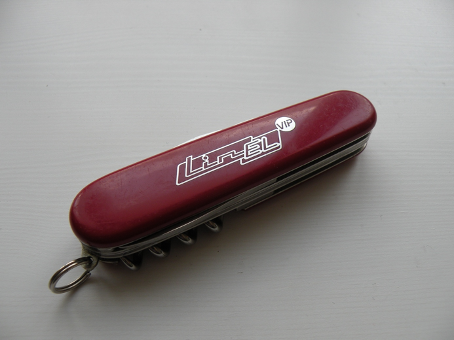
Linel merchandize: a Swiss pocket knife for the publisher’s VIPs. Photo: Roman Werner
LINEL had some connections to other developers and publishers abroad from start on. Among the young developers, it was common practice to exchange information and visit each other and show what you were working on. Early on, the young Argovian devs around Heinz Lüem had invited devs for an exchange, and they came from the UK, Sweden, USA and Germany (Interview with Heinz Lüem by Larissa Wild and David Krummenacher, 2023). Likewise from 1989 on, Markus Grimmer invited many young devs to Appenzell, where he discussed concepts with them, and they worked on several games at the same time and helped each other out (Interview with Guido Henkel by Christian Schmidt und Gunnar Lott). For Grimmer, it was important to get deals with foreign publishers that could guarantee distribution of the games in countries like the UK, USA and D. So, it is not a surprise that cooperation with other studios and publishers took place almost from start on. And in later projects, LINEL always worked in mixed teams with devs from England, Germany; Scandinavia and Switzerland.
Collaborations
Mostly for publishing and distributing purposes, there were collaborations with the following companies (incomplete lists).
Logo used by Hewson Consultants from 1984 on.
Merit Software’s Logo from 1992-96
Frequent publisher collaborators:
Hewson Consultants Ltd. (UK) – Exolon (1987), Eliminator (1987) Players Software (UK) – Eliminator (1987) Merit Software (USA) – Traders: The Intergalactic Trading Game (1991), The Neverending Story II: The Arcade Game (1991) Software 2000 (D) – Der Schatz im Silbersee (1993) Softgold Computerspiele GmbH (D) – Kaiser Deluxe (1995) Clockwork Games Ltd. (UK) – Necronom (1991) Micro Deal Ltd. (UK) – Insanity Fight (1987) Pantheon Software (USA) – The Champ (1988) SYSTEM 4 de Espana S.A. (E) – The Champ (1988) Pactronics (AUS) – The Champ (1988) CCD (D) – Kaiser (1988) Codemasters (UK) – Maze Patrol (1987)
Frequent developer collaborators:
Dragonware Games (UK) – Exolon (1987) Nightrider Software (CH) – Dugger (1988), Crown (1989) 1001 Software Developments (NL) – Baby Bug (1989), Skate of the Art (1989) Lunatic Software (UK) – Necronom (1991) Cybervision (D) – Der Schatz im Silbersee (1993)
Unreleased Games
Some of the cooperation with other publishers and other dev teams didn’t work out. While we know of 20 games that were published with the label LINEL (See part 1) on many platforms, there were some games and projects that didn’t make it in the stores.
Is it already difficult to find and get information on some of LINEL’s published games that were done in collaboration with foreign publishers or international dev teams, it seems to be even harder to get enough information on abandoned game projects. But there are some announcements and in odd cases previews of prototype versions of planned releases that present enough information to list the games as unreleased LINEL projects.
An incomplete list:
Maze Patrol (1987)Dragonslayer (1988) Ice & Fire (1989) Crown (1989) Solaria (1989) Drachen von Laas (1989) Neverending Story II: Das Adventure (1991) Der Schatz im Silbersee (1994) Amiga version Durch die Wüste (1994)
Maze Patrol (1987) was a Commodore 64 game, that was due to be released by LINEL in 1987. Markus Grimmer commissioned the prolific Austrian Listing games designer Roland Mayer with a game that is said to be somewhat like his own Hungry Hoodlum (1987) game that was published by Tronic Verlag GmbH in Compute mit for C64 earlier in 1987. Mayer says that he received a call from Switzerland and was promised that his game would be published by LINEL for a good fee. He developed the game in Assembler, completed it and painted a title cover for Maze Patrol. It was a rather elaborate work that took him many weeks. But the game was never released by LINEL, nor was it released by Codemasters, a well-known English C64 publisher, LINEL tried to cooperate with at the time. Mayer does not know why the game wasn’t released. And he did not get any money either for his extensive work. Musician Helmut Melcher confirmed to researcher Lenny Bronstein (Games that weren’t: 64) in 2020 that they did a composition for Maze Patrol. “In the years 1987 – 1989, I did a few programming and games music jobs for LinEl. In April 4th 1987, I sent the music and music coding to Ronald. I still have a copy of the letter, and a printout of code and data. So: The music and its coding for MazePatrol on C64 stems from me.” (Melcher 2020) A copy of the game has not been found so far.
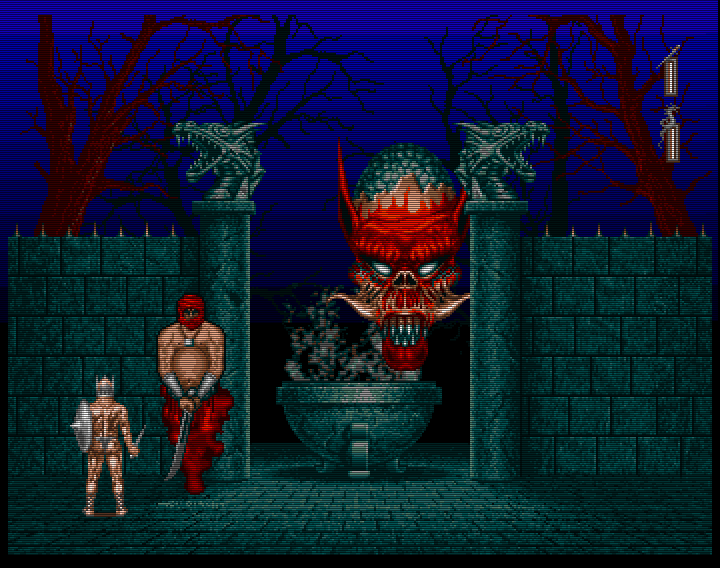
DragonSlayer (1988) by Christian A. Weber was a LINEL project that was announced for January 1989. French previews saw it as an extremely promising title by LINEL. Presentations were delayed and its first screens were finally revealed in November 1989. While gamers‘ expectations were high, the game’s incessant postponements put them to the test. The project was very ambitious. Again in 1990 french media announced the immediate release of DragonSlayer on Amiga, Atari ST and C64, but after that there was silence. It appears that some Dragon sequences have been used in a C64 demo of Rings of Medusa (1989). A few parts from the unreleased game were later used in the follow-up Rings of Medusa Gold. After LINEL had abandoned the project, Starbyte took over, assigned Chris Haller and Roland Petermann to the task and intended to make a Barbarian clone with the title Warrior of Darkness out of the DragonSlayer idea. But Warrior of Darkness faced the same fate at Starbyte and remained unreleased as well. However, Christian A. Weber managed to put a playable demo together on Amiga in 1991. And finally, Starbyte integrated a lot of material into its Rings of Medusa Gold (1994) Amiga version.
Dragonslayer sequence, that has been shared on English Amiga Board (2005). Sreenshot: DamienD
Ice & Fire (1989) was also announced in the Dugger booklet together with Dragonslayer as soon to follow release. The French magazine Generation 4 knows in its issue No.6 that the game is expected on Amiga and Atari ST. It had been announced as an adventure game with many original features such as offering several good endings.
Crown (1989) had been announced by the same French magazine Generation 4 as a strategy game reminiscent of Seven Cities Of Gold. “With almost 58 colors, the game, due for release on ST and Amiga in February 89, promises to be excellent.” The magazine prints one screen with a isometric map view of a city called Dead City showing the LINEL Logo as well as the title Crown.
Solaria (1989) was intended for release in March 1989. Again, the French magazine Generation 4 knows that it is a game that is based on an Aztec sport. Information on Solaria, Crown and Ice & Fire are sparse. Hopefully, there is more to find.
Drachen von Laas (not released in 1989) – a text adventure. The game was completed by the two German devs Guido Henkel and Hans-Jürgen Brändle, prior to signing a contract with Markus Grimmer, manager of LINEL. But the Swiss publisher favored the development of other games and delayed the release of Drachen von Laas over a year amidst money problems. After working on other projects, Henkel had enough in mid 1990 and annulated the contract with Grimmer. Although times were over for selling text adventures well and gamers wanted point’n’click adventures with visuals instead. The text adventure was eventually published by Henkel and Brändle themselves with their new label Attic Entertainment in 1991 for DOS, Amiga and Atari ST.
The release of Neverending Story II: the Arcade Game (1991) in early 1991 in German on Commodore 64 was followed by Amiga, Atari ST and PC versions in French, Italian and English. But the LINEL crew also worked on a a second installment, that was called Neverending Story II – the Adventure. This should have been the start of a classic adventure series. The development of this second game was going to be based on the new MACS engine (Modular Adventure Control System) that Arndt Hasch had developed for LINEL as an answer to Lucas Arts SCUM engine. Unfortunately, there was only a demo version, that made it to PC Joker and was previewed in their 6/91 issue. The reviewers were quite impressed by graphics and especially sound, but the game with the interface that looked rather similar to the classis Scum point’n’click adventures was never finished. Later, the MACS-engine was used for the game Der Schatz im Silbersee (1993).
Der Schatz im Silbersee (Amiga version, not released in 1993/94). The PC-Version was released in 1993 with Software 2000 as publisher. LINEL and Cybervision were the two developer teams, Markus Grimmer was the producer. Michael Tschögl did the animations. According to Mobygames, an Amiga version was developed, but never released. There is a demo version available in the internet. The German magazine Amiga Joker received a test-version and wrote a preview in its 3/94 issue and gave it a good rating of 74%. A first progess report was already written by Hans Ippisch in Amiga Joker 8/93. He visited LINEL and knew that the Amiga version will be similar to the PC-version, and it will come in 256 color graphics (for Amiga 1200). Ippisch’s progress report is worth reading since he describes in detail how script, storyboard and visuals were made. And he also gives some insights about contract negotiations at the Nürnberg book fair of 1992 between the head of the Karl-May-Verlag (books) and LINEL. Der Schatz im Silbersee was the first game by the German publisher Software 2000 of a planned Karl May Edition, a series of Karl May adventures that should have been developed with LINEL.
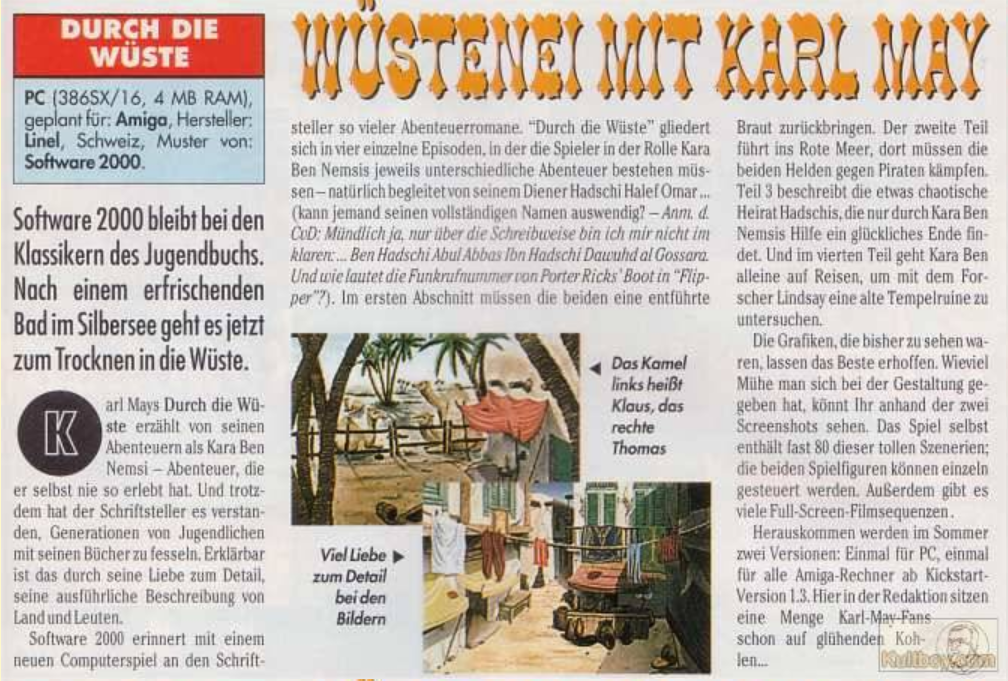
Durch die Wüste (announced but not released in 1994),would have been the second game in a series of three (or four) adventure games about Karl May. The magazine ASM received a sample version for PC, tested it and wrote a preview for its 6/94 issue. It mentions LINEL as developer and announces an Amiga version as well. The sample was from publisher Software 2000. The magazine knows that Durch die Wüste was structured in four episodes, in which the player as Kara Ben Nemsis together with his servant Ben Hadschi has to survive four different adventures. ASM also says that the graphics that it had seen so far leave it hoping for the best. It prints two screenshots from the game and praises the great scenery of which the game contains around 80, says that both characters can be controlled individually as player avatars. And the game contains many full-screen video sequences. Finally, it hopefully announces the release of a PC and an Amiga version for summer 1994. Sound programmer Matthias Steinwachs composed the music for the game. He got his assignment from LINEL-boss Markus Grimmer, who told him, the music for Durch die Wüste should sound oriental, but still oriented to western listening habits. Steinwachs did a thorough research and worked on it for several weeks. He was quite happy with his part and was waiting for the video sequences to finish his project. Unfortunately, they didn’t come – and the game was never released, and the series was abandoned.
The German Magazine Aktueller Software Markt (ASM) announces the expected second installment of a Karl May game series by LINEL in its 6/94 issue. Screen: Kultboy
Besides the 20 games, that Swiss publisher LINEL with temporary headquarters in St.Gallen, Arbon, Vaduz and Herisau had published under its own label in the years 1987 – 1995, there were at least nine more games or projects that had been completed but not released, or were in progress at some point and could be tested as prototypes, but did not make it further than being demo versions for the gaming mags. These games did not find their way onto the Software market.
Die Inputmöglichkeiten per Joystick sind bei den 8- und 16-Bit Homecomputern sehr beschränkt. Das Arcade-Default-Setting (YAMMA) war ja 1 Joystick (4-Richtungen) und 2 Buttons im Minimum.
Das fuehrt bei Ports zur Frage, wie ‚emuliert‘ man den zweiten Knopf? Oder lässt man den beim Gamedesign gar nicht zu? Die Consolen aus den USA (These) hatten nur 2 funktionslgeiche Buttons (Kostengruende?). Die japanischen Konsolen (NES) arbeiteten mit 2 verschiedenen Knöpfen.
Der Ausdauernste (darum auch Beliebteste), Handhabbarste (darum auch Beliebteste) und zugleich (‚zufaelligerweise‘) Arcade visuell ähnlichste Joystick war der CompetitionPro. Die Nutzung war allerdings teilweise anders: Die Leute hielten ihn in der Hand, besonders die später verkaufte Miniversion. Achtung: Die Tasten sind Funktionsgleich. Der Joystick ist also sowohl rechts- wie linkshaendisch nutzbar.
Visuell ueberarbeitete Version, die besser an den Homecomputer ‚passt‘.
Wie lösen die Spiele das Problem des nur einen Knopfs bei Spielkonzepten mit 2 Knöpfen? Der einfachste Lösungsansatz war das Timing. Langes Druecken oder Doppelclick. Genutzt bei R-Type oder Zynaps.
// ToDo: Check Paddle Atari 2600 fuer Pong (Potentiometer – wie lief die Kommunikation?) // ToDo: Vgl. Vectrex mit 4 Knöpfen
Luhmanns Systemtheoriediktat, dass bei Systemen die Grundlage ihres physischen Funktionierens keine Rolle spielt, sondern nur die eigene Autopoiesis, ist letztlich die Kreation eines MagicCircle. Dieser MagicCircle vereinfacht dabei jede Art von Auseinandersetzung und verkuerzt damit die Komplexität als Fokussierung. Man könnte auch sagen: der Tunnelblick oder rhizomatischer: nur ein Plateau.
Schaut man sich die Personen, die die Computerindustrie vorwärtsgetrieben haben – gerade im Home-Privatisierungsbereich an, gibt es da doch einige Personen (wie Sinclair), deren eigener Background und Motivationsdesign wichtig sind und da spielt der Background sehr wohl eine Rolle.
Systemgeschichte
Jack Tramiel hat im System der Computerindustrie zwei wichtige Dinge getan: Er hat eine Firma gegruendet, die nannte er Commodore. Sie stellte zuerst im ‚Lowend‘-Bereich „Rechner“ bereit, zuerst wie fast alle in dieser Branche ‚Rechenmaschinen‘ und danach zuerst Bueromaschinen. Es folgten Homecomputer wie der C16, C20. Der Kauf von 6502 Fabrikant. Dabei war der niedrigste Preis immer das Verkaufsargument – auch bei der verkappten Spielkonsole C64 (8bit). Beim BASIC des C64s war es dann auch zuviel des Billigen (10+ Jahre dasselbe Microsoft Basic). Nach dem Streit in der Firma Commodore, verliess er die Firma und kaufte den neuen Firmenteil Atari und kämpfte mit den Problemen des Videogamecrash und steckte alles in den Atari ST (16/32bit). Dieser sollte die einstige Marktuehrerschaft zurueckbringen. Und der Atari ST war frueher und auch immer billiger als sein Konkurrent Amiga und setzte diesem auch zu. Hier sollte noch geklärt werden, welcher Computer in Sachen Business ’nachhaltiger‘ war.
Die rhizomatische Geschichte
Und ja dann kann man sich fragen: Woher kommt denn Jack Tramiel und was motivierte ihn? Seine Lebensgeschichte ist die, eines von den Nazis-Verschleppten juedischen Polen Idek Trzmie ins Konzentrationslager, befreit von den USA.
Er emmigrierte in die USA, änderte seinen Namen, war Armeeangehöriger, -angestellter und schliesslich startet damit dann die Geschichte, die wir alle im System „Computerentwicklung“ kennen. Dabei sind auch hier Irrrungen und Wirrungen des Alltags nicht dargestellt und damit auch eine Fokussierung, Verkuerzung und Linearisierung.
LINEL was a software developer and publisher based in Switzerland. The label was active from 1987 to 1995. LINEL was founded by seven or eight young Swiss developers in the 1980s. They focused on programming on Amiga and Atari ST, but did some C64 ports and later DOS ports as well. Mobygames credits LINEL for 16 games. These are the following:
Insanity Fight (1987 on Amiga, Atari ST) Exolon (1987 on Amiga, Atari ST, Commodore 64…) Crack (1988 on Amiga) Dugger (1988 on Amiga, Atari ST) Eliminator (1988 on Amiga, Atari ST, Commodore 64…) Kaiser (1988 on DOS, Amiga, Atari ST) The Champ (1989 on Amiga, Commodore 64, ZX Spectrum) Baby Bug (1989 on Amiga) Skate of the Art (1989 on Amiga) The Neverending Story II: The Arcade Game (1990 on C64, Amiga, Atari ST, DOS) Necronom (1991 on Amiga) Traders: The Intergalactic Trading Game (1991 on DOS, Amiga, Atari ST) The Game of Life (1992 on DOS, Amiga) Der Schatz im Silbersee (1993 on DOS) Regent Deluxe (1994 on DOS) Kaiser Deluxe (1995 on DOS)
This Logo was used by LINEL from 1987 – 1993
The Website LemonAmiga comes up with three more LINEL games published on Amiga. For the first two there is only little public information available.
Gnome (1991 on Amiga) Kiro’s Quest (1992 on Amiga) Regent v.2.0 (1992 on Amiga)
And Lemoamiga dates a version of Kaiser on Amiga for 1989. Most likely the two different releases Regent v2.0 on Amiga and Regent Deluxe on DOS were similar versions of the same game, but the releases were three years apart and Regent Deluxe came as a remake with much better graphics and was completely done in German. All in all, so far, we know of 19 games published by LINEL Trading GmbH in a period of 9 years.
LINEL’s Logo for the years from 1993 – 1995
3 games were ported to other platforms: Exolon, Kaiser and Eliminator. 7 were developed by Swiss dev teams: Insanity Fight, Crack, Dugger, The Champ, Necronom, Traders and the Game of Life (The Golden Gate Crew). 2 games were developed by a small British team called Vision: Gnome, Kiro’s Quest. And 2 by a Dutch dev crew: Baby Bug, Skate of the Art. This leaves 4 games that were developed in mixed crews with German, Swiss and other devs, whereas some teams were bigger and had mostly German devs as for Der Schatz im Silbersee (Cybervision).
In 1989, LINEL signed a contract with two German developers, Guido Henkel and Hans-Jürgen Bräunle, to publish their game Drachen von Laas after the two fell out with German publisher Ariolasoft. The two developers called themselves Dragonware. LINEL is said to have been primarily interested in marketing the text adventure Ooze (also by Henkel and Brändle) in the UK and would have delayed the release of Drachen von Laas, so the two German developers terminated the contract in 1990 and eventually released the game under their own label Attic Entertainment.
From developer Guido Henkel also comes the information that he himself did the Amiga port of Kaiser in1989 for LINEL. Furthermore, LINEL was allowed to release the game Ooze on the British market at the same time with a new cover that impressed Henkel. All three UK-versions were published with the Dragonware label (not LINEL), but had LINEL’s address in Liechtenstein on the back of the box-cover, where they were produced at Merimpex AG.
Overall, we now know of 20 games, which the Swiss publisher LINEL with temporary headquarters in St.Gallen, Liechtenstein and Appenzell had published under its own label in the years 1987 – 1995.
Geht es um den Versuch plastisch zu gestalten, ist das Medium C64 im Multicolor-Mode und bei den Sprites schwierig. Die einfachste Sache: Verwenden der 2 Fuer-Alle-Gleich-Farben als eine Art Lichtschattierungradient und die Zeichenfarbe als die Hauptfarbe. Dadurch ergeben sich zumindest zwei mögliche Designstrategien, die zu unterschiedlichen Eindruecken fuehren.
Front-Farbe-Konzept: Die wählbare Farbe ist zu vorderst und erscheint damit als Hauptfarbe. Die meist Graustufen, erzeugen dann den Hintergrundeffekt.Selbstverständlich lassen sich die Graustufen dann auch fuer technische Sachen etc. nutzen.
Sandwich-Farb-Konzept: Die nicht-wählbaren Farben decken, die dunkelste und die hellste Farbe ab. Die wählbare Farbe ist dann zwischen diesen zwei Farben.
Im besten Fall erscheint dann das Ganze sehr kontrastreich und kann Comics-Aesthetik annehmen. Im schlechtesten Falls ist dann alles viel zu hell und eintönig.
Hier ein eigene Designbeispiel aus dem entstehenden Spiel „Holy Cube“. Wobei hier auch noch zusätzlich auf den Rotationseffekt gesetzt wird.
Selbstverständlich lassen sich diese beiden Techniken auch kombinieren. Sie sind auch nicht die einzigen, die man in der freien Wildbahn sieht.
„Coden“ war oft ein Navigieren in einem stetig wachsenden und komplexer werdenden Source-Code. Der Code war mehr oder minder ein Plaintext. Meist die einzige Möglichkeit nicht muehsam scrollen zu muessen (Scrollen per Mouse war anfangs nicht vorhanden und ist sehr ineffizient bei viel Code), sondern direkt hinzuspringen war die Suche. Was kann man suchen?
– Sprungmarken oder Funktionen (was in Assembler dasselbe ist) – Variablen-Namen – Spezieller Code – Kommentare
Das war und ist egal ob es Spaghetti-Code war oder nicht.
// Code completion war selbstverständlich auch nicht vorhanden.
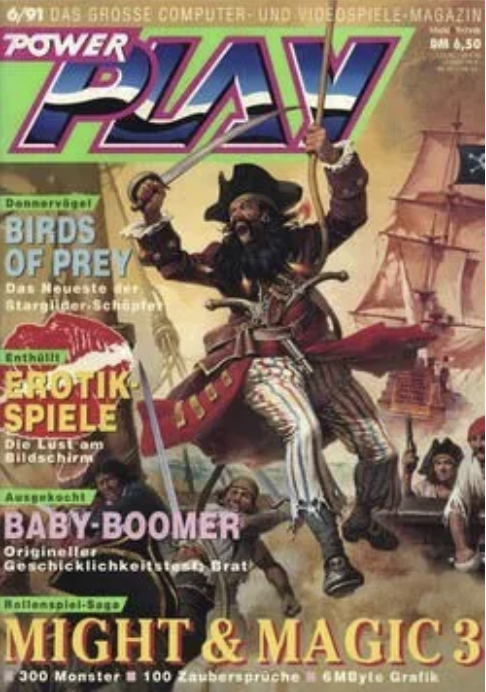
Powerplay entstand als Sonderbeilage fuer die Video- bzw. vorallem Computergames im HappyComputer und wurde dann spezialisiert ausgegliedert. Das heisst: Games waren als Medium und Community-bildend wichtig genug (auch finanziell), um als eigenes Medium eigene Besprechungsorgane zu haben. Damit endet auch ein Teil der All-In-Computermagazine.
Geschätzt wurde das „PowerPlay“ auch wegen seiner unabhängigen Art Spiele zu besprechen (anders als andere Magazine, die eher (gekaufte?) PR machten) und zu bewerten. Es gab jeweils zwei Personen, die das Spiel textlich bewerteten und dies floss in eine Gesamtbewertung ein. Da diese unterschiedliche Profile abdeckten, konnte man mit der Zeit sehen, welche Einschätzungen „man“ teile. Ein „Gut“ war ok, ein „Super“ war dann auch meist ein Knueller. Aus heutiger Sicht muss man auch sagen, dass die Spielmechanik meist im Fokus der Analyse lag. Wie das Magazin – anders als heute – so unabhängig sein konnte, erklaert sich vermutlich mit der Abhängigkeit vom Publikum (Kioskverkäufe) und wenig Werbung.
Besonders bekannt wurde auch der Comic Starkiller, der eine Art MetaCritic der Gamebranche war und auch immer die Designerperspektive ‚diskutierte‘ und hinterfragte: Starkiller – Die Geißel der Galaxis
// ToDo: Businessmodell vom PowerPlay vs ander Magazine wie ASM.
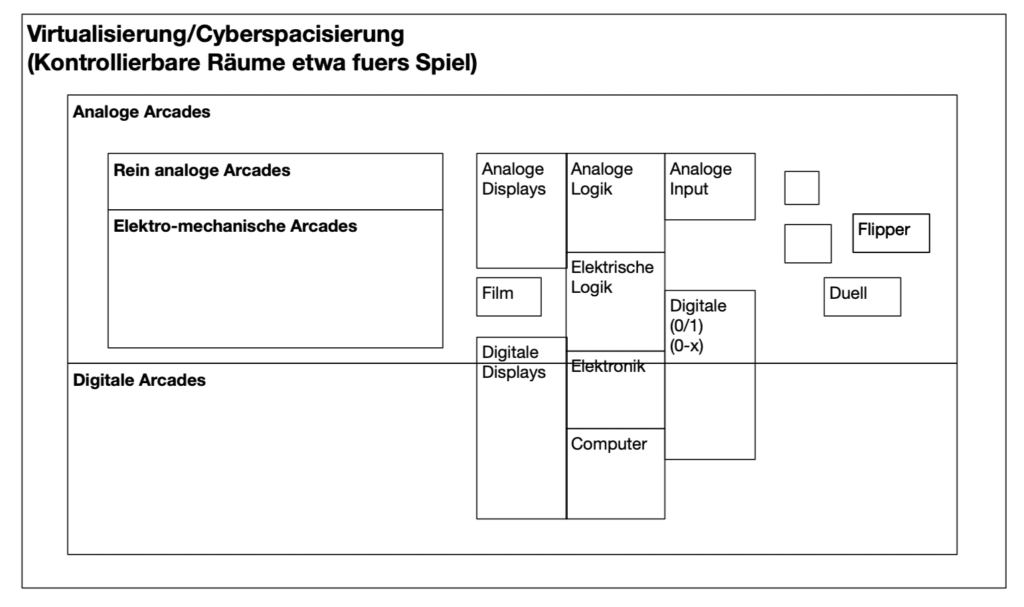
Letztlich ist die Digitalisierung nur eine Untermenge eines viel grösseren gesellschaftlich technologischen Prozesses: Der Virtualisierung oder Cyberspacisierung. Dabei geht es nicht nur darum, Dinge zu virtualisieren sondern auch neue Dinge zu ermöglichen. Dies wird gerade anhand des GameDesigns und der Spielgeschichte deutlich. In diesem Bereich geht es letztlich endlich auch um Kontrolle und kontrollierbare Spaces. Also Spaces, die man nutzen kann, um Spiele zu entwickeln und produzieren. Optional ist ja Interaktion immer dabei in Games. Dabei sind die Spiele natuerlich nur ein Teil des Trends. Dieser Trend lässt sich auf einer Metaebene so zusammenfassen: Mehr Kontrolle und dies erreicht man am einfachsten durch kontrollierbare Regeln. Damit setzt sich eine Bestrebung fort von Sklaven bis zur Digitalisierung bis hin zu Tools wie AI (wobei kontrollierbaren Regeln hier gerade nur die Trainingsdaten sind – Kybernetik pur) und etwa GenEditing.
Aus heutiger Perspektive vergisst man diesen Grosstrend, weil zu sehr die Digitalisierung im Vordergrund steht und alles nur im Rahmen der Digitalisierung gesehen wird, dabei zeigt gerade die Entwicklung der Spielewelten, dass viel mehr da war, ueberschrieben wird (The medium is the message) und vieles weiterhin existiert. Die ‚Verluste‘ dieser Virtualisierungen werden dabei wenig bis gar nicht diskutiert. Es geht ja um Kontrolle und damit verlagert man den Diskurs in diesen neuen Space. Radikal kommt bei den rein virtuellen Games hinzu, dass sie fast keinen analogen Space mehr benuetzen und darum auch nicht um diesen Kaempfen muessen. Der Nachteil ist auch bekannt: keine wirkliche Anerkennung als Kulturgut.